The single most common bidding mistake contractors make on demolition and renovation work is treating concrete disposal as a one-line cost: load it, truck it, pay the dump fee, move on. The bid sheet says “disposal: $X per ton” and the contractor either eats the cost or passes it through. The full economic picture — what concrete disposal actually costs across loader handling, trucking, tipping fees, replacement aggregate purchase, and project schedule impact — is meaningfully larger than the dump fee alone, and it has been growing larger every year as tipping fees have continued to climb. The contractor who treats disposal as one line is leaving margin on the table; the contractor who counts the full cycle finds that on-site crushing is increasingly the cheaper path on the kind of work most contractors do every week.
The Environmental Research and Education Foundation’s 2024 Analysis of MSW Landfill Tipping Fees — the most comprehensive U.S. landfill pricing dataset published — documents the trend. National average MSW tipping fees reached $62.28 per ton in 2024, up 10 percent from $56.80 per ton in 2023 (the largest single-year increase since 2022) and roughly 30 percent in inflation-adjusted terms since 2016. C&D-accepting landfills average $65.84 per ton nationally. Northeast averages exceed $80 per ton. Pacific region averages $72.88 per ton, up 17 percent in 2024 alone. The economic environment that made on-site crushing a marginal proposition five years ago has shifted decisively in favor of recycling, and the trajectory of continued tipping fee increases plus rising virgin aggregate prices points toward the case getting stronger through the late 2020s.
This guide is the contractor’s economic reference for the haul-away-versus-crush-on-site decision. It covers the full cost-line breakdown that most bid sheets miss, the EREF 2024 data and regional patterns that determine which side of the equation any specific operation falls on, the equipment scale and capital math that determines when ownership pays back, the break-even formulas that turn the comparison into an actionable number for any project or operation, the qualitative factors that change the analysis (site access, schedule pressure, contamination, regulatory environment), and worked examples for the application categories where on-site crushing most consistently wins. The audience is the demolition contractor, hardscape contractor, site contractor, recycler, and any general contractor whose work routinely generates concrete demolition rubble.
Komplet America has been the U.S. distributor of Komplet S.p.A. compact crushers, screeners, and shredders since 2018, and the Conti family construction legacy behind Komplet America stretches back to 1906. The economic analysis in this article is the conversation our specialists have with virtually every prospective customer who calls — the math behind whether owning compact crushing equipment makes sense for their specific operation. The detail below is the broader context for those conversations, applicable to operations in every U.S. region.
The Quick Answer
For contractors who don’t need the full analysis:
- Haul-away disposal is the right answer for small-volume operations (under approximately 1,000 tons per year of concrete demolition), contaminated mixed feed that’s hard to clean, jobs with no site access for crushing equipment, projects where the schedule cannot accommodate processing time, and markets where dump fees are very low (parts of South Central with abundant landfill capacity).
- On-site crushing is the right answer for operations with clean concrete volume of approximately 1,000 tons per year or more, repeat work that keeps equipment productive, available site or yard space for processing and stockpiling, project mix that can consume the produced aggregate (or local market that buys it), and regional economics with meaningful tipping fees and virgin aggregate prices.
- The full cost-line comparison includes loader handling (same in both scenarios), trucking out (eliminated by on-site), tipping fees (eliminated by on-site, averaging $44-$80+ per ton by region per EREF 2024), virgin aggregate purchase (offset by reuse, varies widely by region), and on-site production costs (equipment amortization, labor, fuel, wear parts, permitting).
- Equipment scale matches operation: K-JC 503 mini jaw crusher for small operations (5,000 tons/year or less), K-JC 604 or K-JC 704 PLUS for medium operations, K-JC 805 for higher volumes. Pre-owned equipment cuts capital by 40-70 percent.
- Pay-back timelines vary by region and operation. In high-cost regions (Northeast, Pacific), payback on compact crushing equipment commonly runs 18-36 months for moderate-volume operations. In medium-cost regions, payback runs 24-48 months. In lower-cost regions, payback runs 36-60 months or longer.
The Full Cost-Line Breakdown: What Disposal Actually Costs
Concrete disposal looks like a one-line cost on the bid sheet, but the full economic picture has at least six distinct cost categories. The contractor calculating disposal cost as just the tipping fee is undercounting the actual project cost by a meaningful percentage. The exact percentage varies by region, project, and operation, but the framework below is the universal accounting.
Cost Bucket 1: Loader Handling
Before concrete leaves the site, the demolition rubble has to be broken down, sorted, and loaded onto trucks. Loader time, operator wages, fuel for the loader, and any required pre-breaking with an excavator-mounted hydraulic breaker all factor in. This cost is the same in both scenarios — haul-away or crush-on-site — because the loader handles the material into either a truck or a crusher hopper. Loader handling typically runs $4–$10 per ton depending on operation scale, equipment owned versus rented, and the level of pre-breaking required.
The neutral nature of this cost bucket means it doesn’t drive the haul-away vs. crush decision. It does, however, set the operational baseline: contractors who can’t efficiently handle the loader work on site (no space, no equipment, no operator) will struggle with either scenario.
Cost Bucket 2: Trucking Out
Hauling concrete demolition rubble to a disposal facility uses truck capacity, driver time, fuel, insurance, and jobsite coordination. The cost scales with round-trip distance and time, not just one-way distance. A 30-mile one-way haul to a disposal site might mean 90+ minutes round-trip per load including loading time, dump time, and return — even before traffic delays. At typical regional trucking rates of $100–$200 per hour for a tri-axle dump truck, the trucking cost alone can run $20–$60 per ton on moderate-distance hauls. Long hauls to scarce disposal sites in capacity-constrained regions can push trucking cost above the tipping fee itself.
On-site crushing eliminates this cost entirely. The material doesn’t leave the site; the equipment goes to the material rather than the material going to a disposal site. For operations that already own loaders and excavators for their normal work, on-site crushing leverages equipment that’s already paid for, while haul-away requires either owned trucks (with their own capital cost line) or rented trucks (with hourly billing).
Cost Bucket 3: Tipping Fees
Tipping fees — the per-ton charge at the disposal gate — are the visible cost line on most disposal calculations. EREF’s 2024 Analysis of Municipal Solid Waste Landfill Tipping Fees documents the current pricing environment in detail. National averages and regional patterns:
- National MSW average: $62.28 per ton (2024), up 10 percent from 2023.
- National C&D-accepting landfill average: $65.84 per ton (2024).
- Northeast regional average: approximately $80.67 per ton — highest in the nation.
- Pacific regional average: approximately $72.88 per ton — second-highest, up 17 percent in 2024 alone.
- Mountains/Plains regional average: approximately $58 per ton.
- Midwest regional average: approximately $50 per ton.
- Southeast regional average: approximately $48 per ton.
- South Central regional average: approximately $44.87 per ton — lowest in the nation.
- State extremes: Mississippi at $31.90 per ton (lowest), Alaska at $124.25 per ton (highest).
Tipping fees have grown approximately 30 percent in inflation-adjusted terms since 2016. The trend is consistently upward across all regions, with capacity-constrained markets (Northeast in particular) seeing the steepest increases. For the broader analysis of regional tipping fee patterns and the regulatory drivers behind them, see Construction & Demolition Tipping Fees by Region: A Contractor’s 2026 Reference.
Cost Bucket 4: Virgin Aggregate Purchase
Many concrete demolition projects also need aggregate to come back to the site — for backfill, base, slab base, driveway repair, structural fill, or pipe bedding. When concrete is hauled away to a disposal site, the project pays separately for virgin aggregate delivery, doubling the trucking exposure (one load out, one load back) and adding the material cost.
Virgin aggregate pricing has continued to rise in lockstep with energy, labor, and permitting costs at virgin quarries. Typical residential and light commercial virgin aggregate pricing in 2026:
- Crusher run / dense-graded aggregate: $25–$50 per ton delivered, depending on region and hauling distance.
- AASHTO #57 stone: $30–$55 per ton delivered.
- AASHTO #67 or smaller sizes: $32–$60 per ton delivered.
- Premium washed stone (concrete grade, drainage): $40–$80 per ton delivered.
On-site crushing eliminates this cost line when the produced aggregate can be used on the same project or in the contractor’s own operation. The contractor producing recycled #57 stone from demolition rubble and using it as the lower drainage layer of the next driveway is, in effect, getting paid twice for the same load of concrete — once because they didn’t dump it, once because they didn’t have to buy aggregate for the next job. We cover the full RCA versus virgin economic and performance comparison in our companion piece, Recycled Concrete Aggregate vs Virgin Stone: A Contractor’s Guide.
Cost Bucket 5: Project Schedule Impact
Disposal logistics affect project schedule. Trucking dispatch, dump site hours, queue times at the dump, traffic delays — all create variability that can ripple into project completion dates. For projects with binding completion deadlines (penalty clauses, occupancy requirements, follow-on contractor schedules), schedule risk is a real cost that’s hard to quantify but consistently meaningful.
On-site crushing typically reduces schedule variability because the contractor controls the entire material flow. There’s no third-party trucking dispatcher, no dump site closure to navigate, no queue at the recycler’s gate. The trade-off is processing time on-site, which can be a constraint in tight schedules — though most modern compact crushers can keep pace with normal demolition production rates without becoming the bottleneck.
Cost Bucket 6: On-Site Production Costs
On-site crushing adds its own cost lines that haul-away avoids:
- Equipment cost (capital amortized over operating life): for compact crushing operations, 5–10 year amortization is typical. Pre-owned Komplet equipment offers 40–70 percent capital savings versus new, with the same factory service network behind every machine.
- Wear parts: jaw plates, blow bars (for impact crushers), screen mesh, and supporting wear items. The largest variable cost line after fuel and operator wages. We cover wear parts economics in detail in Wear Parts Economics: Jaw Plates, Blow Bars, and Screen Mesh.
- Fuel for the crusher and supporting equipment.
- Operator wages — though many compact crushers run with a single operator who’s also operating the loader, eliminating the dedicated crusher operator cost line.
- Permitting and ongoing compliance: state and local environmental permits, air quality, stormwater, OSHA silica compliance. State-by-state variation is substantial. See Permit Guide: Starting a Small-Scale Concrete Recycling Operation for the framework.
- Insurance and miscellaneous overhead.
The Break-Even Math
The economic comparison between haul-away and on-site crushing can be reduced to a single formula:
Net economic value of on-site crushing = (Avoided disposal cost) + (Avoided aggregate cost) – (On-site production cost)
If the net value is positive across the projected operating volume, on-site crushing is the economically rational choice. If it’s negative, haul-away is. The components break out as follows:
Avoided Disposal Cost
- Trucking out: round-trip trucking cost per ton × tons of concrete demolition
- Tipping fees: regional average tipping fee per ton × tons of concrete demolition
- Disposal handling: any additional costs at the disposal facility (sorting fees, weighbridge fees, etc.)
Avoided Aggregate Cost
- Delivered cost of replacement virgin aggregate × tons of recycled product the operation can consume or sell
- Adjusted for the fraction of demolition output that’s marketable or usable (typically 80–95 percent of demolition concrete becomes usable RCA after screening; the balance is fines or oversize that requires further processing or separate disposal)
On-Site Production Cost
- Equipment amortization per ton: total equipment cost ÷ tons produced over the amortization period
- Wear parts per ton: typically $0.50–$3 per ton in compact concrete recycling, varying by metallurgy, throughput, and feed quality
- Fuel per ton: typically $1.50–$3 per ton in compact concrete recycling
- Labor per ton: varies by operation; the contractor running the crusher with their existing loader operator pays only the crusher’s incremental operator time, while dedicated crusher operations carry full operator wages
- Permitting and overhead per ton: spread across annual tonnage; higher per-ton for low-volume operations, lower per-ton for high-volume operations
Worked Examples by Operation Scale
The break-even math becomes concrete when applied to specific operation scales and regional economic environments. The examples below are illustrative — based on typical industry patterns rather than any specific operation — but the framework applies to any contractor running real numbers for their own situation.
Example 1: Small Hardscape Contractor, Northeast
Operation profile: residential hardscape contractor in a Northeast metro market. Generates approximately 1,500 tons per year of clean concrete demolition rubble from driveway, patio, and walkway tear-outs. Also purchases approximately 800 tons per year of virgin aggregate for new hardscape installations. Tipping fees at local C&D-accepting landfill: $80 per ton plus trucking. Round-trip trucking: $25 per ton.
Haul-away annual cost:
- Tipping: 1,500 tons × $80 = $120,000
- Trucking out: 1,500 tons × $25 = $37,500
- Virgin aggregate purchase: 800 tons × $42 = $33,600
- Total: $191,100 per year
On-site crushing annual cost (illustrative with a K-JC 503 + Kompatto 221):
- Equipment amortization (pre-owned, 7-year): roughly $25,000–$35,000 per year
- Wear parts: 1,500 tons × $1.50 = $2,250
- Fuel: 1,500 tons × $2 = $3,000
- Permitting and overhead: $5,000–$10,000
- Incremental operator time: $5,000–$10,000
- Total: $40,000–$60,000 per year
Net savings: approximately $130,000–$150,000 per year. The pre-owned K-JC 503 paid for itself in well under a year on the disposal cost line alone.
Example 2: Medium Demolition Contractor, Mid-Atlantic
Operation profile: demolition contractor handling commercial and residential demolition in a Mid-Atlantic metro. Generates approximately 8,000 tons per year of concrete demolition rubble. Some material is reused on follow-on jobs; most is sold or used as recycled aggregate. Tipping fees: $55 per ton. Round-trip trucking: $20 per ton.
Haul-away annual cost:
- Tipping: 8,000 tons × $55 = $440,000
- Trucking out: 8,000 tons × $20 = $160,000
- Total: $600,000 per year (no virgin aggregate purchase in this scenario)
On-site/in-yard crushing annual cost (illustrative with a new K-JC 704 PLUS + Kompatto 5030):
- Equipment amortization (new, 7-year): roughly $80,000–$110,000 per year
- Wear parts: 8,000 tons × $1.75 = $14,000
- Fuel: 8,000 tons × $2 = $16,000
- Permitting and compliance: $15,000–$25,000
- Dedicated operator: $50,000–$70,000
- Total: $175,000–$235,000 per year
Net savings: approximately $365,000–$425,000 per year. Plus revenue from selling produced aggregate to other contractors at $20–$30 per ton ($160,000–$240,000 if 80 percent of production is sold).
Example 3: Small Site Contractor, South Central
Operation profile: site contractor in a South Central metro generating approximately 800 tons per year of concrete demolition rubble. Tipping fees in the lower-cost regional environment: $35 per ton. Round-trip trucking: $15 per ton. Virgin aggregate locally available at $24 per ton delivered.
Haul-away annual cost:
- Tipping: 800 tons × $35 = $28,000
- Trucking out: 800 tons × $15 = $12,000
- Total: $40,000 per year
On-site crushing annual cost (illustrative):
- Equipment amortization (small K-JC 503 pre-owned, 7-year): roughly $20,000–$30,000 per year
- Wear parts, fuel, permitting, incremental operator: roughly $10,000–$15,000
- Total: $30,000–$45,000 per year
Net result: roughly break-even to modest savings. In this lower-volume, lower-fee scenario, on-site crushing is a close call rather than a clear winner. The decision should weigh qualitative factors heavily — site access, schedule flexibility, business growth plans, equipment fit for adjacent work.
Regional Patterns
The economic case for on-site crushing varies systematically by region. The patterns below cover the major U.S. regional environments based on EREF 2024 data and typical regional virgin aggregate pricing.
Northeast (Highest-Favorability Region)
Tipping fees average $80+ per ton. Pacific-region-tier trucking costs in many urban markets. Strong demand for recycled aggregate. State DOTs broadly accept RCA. Regulatory environment supports recycling.
- Compact crusher payback for moderate-volume operations: typically 18–30 months.
- Operating volume break-even: as low as 500–800 tons per year for the smallest equipment.
- Most operations in this region that handle any meaningful concrete demolition volume should be running the numbers on owned equipment.
Pacific (High-Favorability Region)
Regional average $72.88 per ton, up 17 percent in 2024. Heavy regulatory framework (California’s CALGreen, mandatory C&D recycling rates). Active recycling infrastructure. High virgin aggregate prices in coastal markets.
- Compact crusher payback for moderate-volume operations: typically 24–36 months.
- Operating volume break-even: 800–1,500 tons per year.
- California’s 65 percent CALGreen C&D diversion mandate adds regulatory pressure beyond pure economic case.
Mountain/Plains, Midwest, Southeast (Medium-Favorability Regions)
Tipping fees ranging from $48 (Southeast) to $58 (Mountains/Plains). Moderate trucking costs in most metros. Active but not dominant recycling infrastructure. State DOT acceptance variable.
- Compact crusher payback for moderate-volume operations: typically 30–48 months.
- Operating volume break-even: 1,500–3,000 tons per year for new equipment, lower for pre-owned.
- Florida is an outlier with stronger economics than the regional average suggests (active infrastructure, FDOT acceptance, hurricane-driven demolition volume).
South Central (Lower-Favorability Region)
Regional average $44.87 per ton. Lower trucking costs in many markets. Abundant landfill capacity. State DOT acceptance variable (Texas’s Type D classification under Item 247 is favorable).
- Compact crusher payback for moderate-volume operations: typically 36–60 months.
- Operating volume break-even: 3,000–5,000 tons per year for new equipment.
- Pre-owned equipment is essentially mandatory for marginal-economics cases.
- Tipping fees in this region have been climbing in recent years, narrowing the gap with the national average. The case improves every year.
Qualitative Factors That Change the Analysis
The break-even math captures the quantitative case. Several qualitative factors can shift the decision in either direction — sometimes substantially. These factors don’t always show up cleanly in the cost-line accounting, but they’re real considerations for any specific operation:
Factors That Strengthen the On-Site Crushing Case
- Repeat work: the contractor whose project flow includes regular concrete demolition has a more predictable case for owned equipment than the contractor with episodic demolition. Equipment that sits idle is expensive amortization.
- Vertical integration: the contractor producing aggregate for their own follow-on jobs captures both the disposal savings and the aggregate purchase savings without needing to operate a separate sales channel for the recycled product.
- Site access and yard space: operations with adequate stockpile space and processing area face fewer logistical constraints than operations in tight urban yards.
- Existing equipment fleet: contractors who already own loaders, excavators, and tracking equipment can leverage existing equipment for the support functions, reducing the incremental cost of adding crushing capability.
- Regulatory environment: states with mandatory C&D recycling requirements (California, parts of the Northeast) add regulatory pressure on top of the economic case. The contractor avoiding hauler permit requirements (NYC’s Business Integrity Commission, LA’s certified processor requirement) benefits from owning the production capability.
- Sustainability requirements: LEED-pursuing projects and federal Buy Clean compliance favor on-site recycling for both the C&D diversion credit and the recycled content credit.
Factors That Weaken the On-Site Crushing Case
- Tight urban sites with no space for processing or stockpiling.
- Contaminated mixed C&D feed that’s hard to clean (heavy asbestos history, complex contamination, mixed-material loads).
- Episodic demolition with long gaps between projects — equipment sits idle and depreciates without producing revenue.
- Schedule constraints that don’t accommodate processing time.
- Capital constraints that make even pre-owned equipment a stretch.
- No internal demand for produced aggregate and no local market for sales — though this is increasingly rare given how widely RCA is accepted.
- Restrictive permitting environments that add substantial cost and time to startup. New Jersey’s framework, for example, can run into six figures and 12–18 months for a fixed in-yard operation. See Permit Guide: Starting a Small-Scale Concrete Recycling Operation for the state-by-state framework.
Equipment Investment by Operation Profile
Hardscape and Small Demolition Contractors
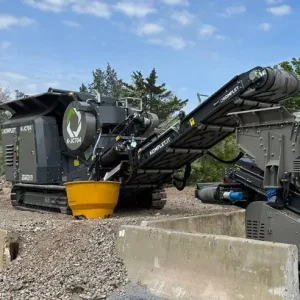
Typical operation: under 5,000 tons per year of concrete demolition. Strong fit for the K-JC 503 mini mobile jaw crusher paired with a Kompatto 221 vibrating screener.
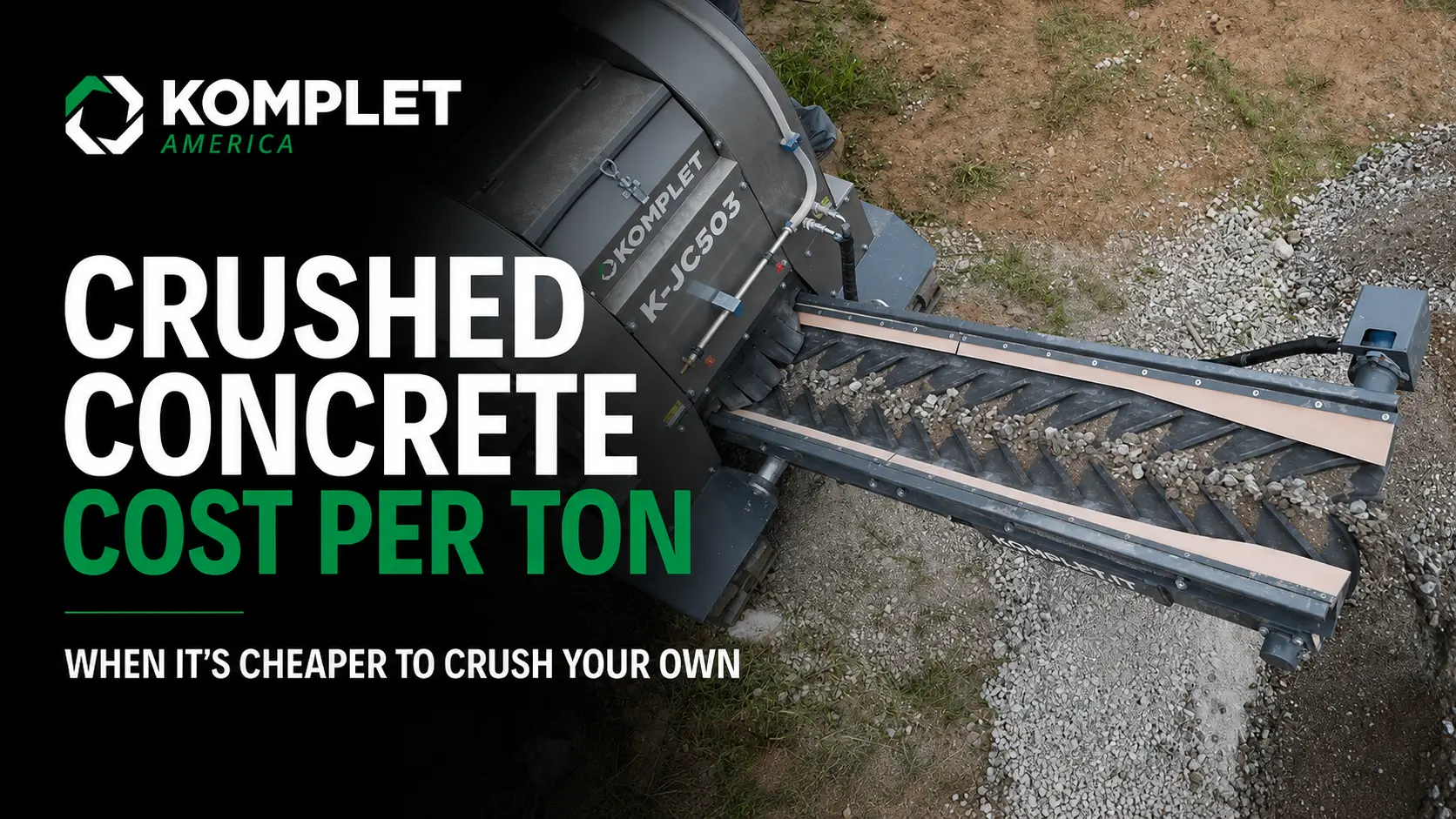
- K-JC 503: 19-inch by 12-inch jaw, up to 34 US tph, towable behind a standard truck. Entry-level production machine.
- Kompatto 221 vibrating screener: compact screener for sized aggregate production.
- Pre-owned configuration typically saves 40–70 percent capital versus new.
- Strong payback economics in Northeast and Pacific regions; modest economics in lower-cost regions but improving every year.
Medium-Volume Recyclers and Demolition Firms
Typical operation: 5,000–25,000 tons per year of concrete demolition. Strong fit for the K-JC 604 or K-JC 704 PLUS jaw crusher paired with a Kompatto 5030 vibrating screener.
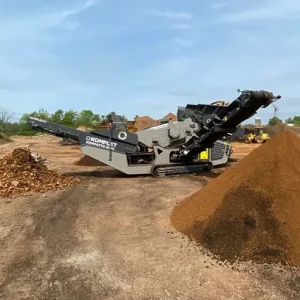
- K-JC 604: 23-inch by 16-inch jaw, up to 55 US tph, integrated hydraulic magnetic belt for rebar separation.
- K-JC 704 PLUS: 27-inch by 16-inch jaw, up to 90 US tph. Komplet America’s best-selling jaw crusher.
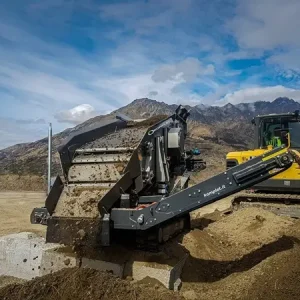
- Kompatto 5030 heavy-duty vibrating screener: three-deck configuration produces three sized products simultaneously.
- K-TC 460 portable mobile conveyor: stockpile management.
- Strong economics across most U.S. regions. Pre-owned equipment continues to improve the case.
Larger Recycling Operations
Typical operation: 25,000+ tons per year, often selling produced aggregate as a primary revenue stream. Strong fit for the K-JC 704 PLUS or K-JC 805 paired with the Kompatto 124 mobile screener.
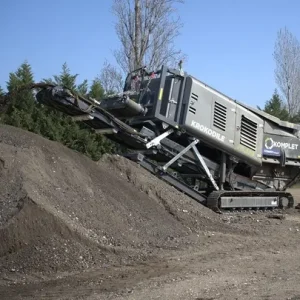
- K-JC 805: 31-inch by 21-inch jaw, up to 160 US tph. Small-quarry-scale operations.
- Optional K-IC 70 compact impact crusher for cubical aggregate production where state DOT specifications require particle shape control.
- Kompatto 124 mobile screener: highest-throughput compact screener.
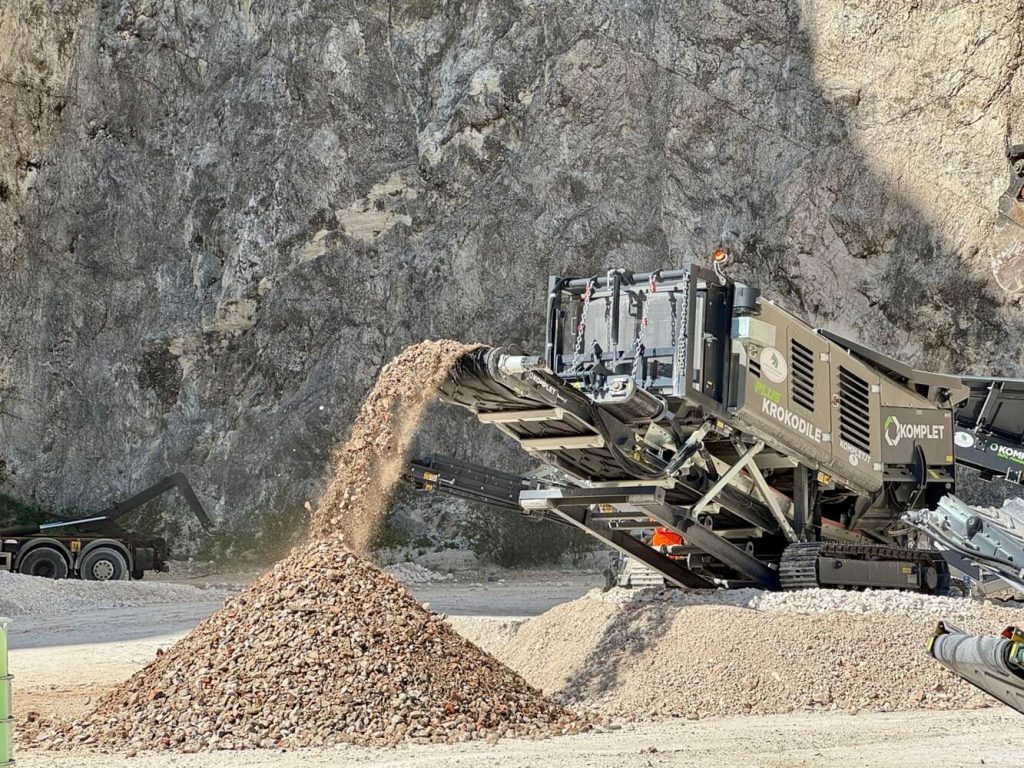
- Krokodile PLUS slow-speed shredder for pre-reduction of mixed C&D feed.
- Operations at this scale typically include dedicated stockpile yards, multiple sized product streams, and active state DOT supply contracts.
Common Mistakes Contractors Make
Comparing the Wrong Numbers
The single most common mistake is comparing a crusher payment to a single dump ticket. The economic decision is between the full disposal cycle (loader handling, trucking, tipping, replacement aggregate purchase, schedule impact) and the full on-site cycle (equipment amortization, wear parts, fuel, operator, permitting). Most contractors who run the right comparison find on-site crushing favorable in conditions where the dump-ticket comparison made it look marginal.
Overestimating Operating Costs
New operators often overestimate operating costs by assuming worst-case wear part life, full-time dedicated operator wages (when most compact operations run with shared operators), and pessimistic fuel consumption. Real operating costs across the Komplet customer base typically run 30-50 percent below initial budget estimates for operators who weren’t familiar with compact crusher economics. The case is usually more favorable than first-pass analysis suggests.
Underestimating Permitting Time
The economic case can be solid while the permitting timeline still kills the schedule. In high-regulation states (New Jersey, California, New York City), permitting for an in-yard recycling operation can take 12–18 months from initial application to operation. Buying equipment before permits are confirmed creates pressure to operate without full compliance. Permits first; equipment second; operations third. See Permit Guide: Starting a Small-Scale Concrete Recycling Operation for the detailed state-by-state framework.
Ignoring the Adjacent Equipment Pull
Compact crushing equipment opens secondary opportunities beyond the original concrete recycling use case. The K-JC 704 PLUS that’s bought for concrete recycling can also crush asphalt millings, brick, block, and natural rock for the same operation. The Kompatto 5030 screener can screen topsoil, compost, and other granular materials. The K-TC 460 conveyor handles aggregate loadout, soil moves, and any granular stockpile work. The economic case for compact equipment improves when adjacent use cases are factored in.
Not Pricing the Schedule Value
On-site crushing eliminates the schedule risk of disposal logistics — dispatching, dump site queues, traffic delays, recycler hours. For contractors with binding completion deadlines or penalty clauses, schedule certainty is a quantifiable value that doesn’t show up in straight cost-per-ton comparisons but consistently matters in real operating environments.
Frequently Asked Questions
Is it cheaper to crush concrete on site or haul it away?
Depends on operation volume, regional tipping fees, and the contractor’s project mix. For operations with clean concrete volume of approximately 1,000 tons per year or more in regions with moderate to high tipping fees, on-site crushing is typically meaningfully cheaper across the full cost cycle (loader handling, trucking, tipping fees, replacement aggregate purchase, schedule impact, on-site production costs). In high-fee regions (Northeast, Pacific), the break-even volume can be substantially lower. In low-fee regions (South Central), the break-even volume is higher. The full economic comparison should always be run with regional-specific numbers.
What’s the typical tipping fee for concrete?
Per the Environmental Research and Education Foundation’s 2024 Analysis of MSW Landfill Tipping Fees: national C&D-accepting landfill average is $65.84 per ton. Regional averages range from $44.87 per ton in South Central to $80.67 per ton in the Northeast. Specific facility rates can be substantially higher in capacity-constrained metros (Northeast metros routinely exceed $100 per ton; New York City’s Sullivan County reached $150 per ton in 2025). Confirm current rates directly with the disposal facility before any specific project bid.
What volume justifies buying a concrete crusher?
Varies by region. In high-cost regions (Northeast, Pacific), 500–1,500 tons per year can justify a pre-owned compact jaw crusher (K-JC 503 or K-JC 604 class). In medium-cost regions, 1,500–3,000 tons per year is the typical threshold. In low-cost regions, 3,000–5,000 tons per year is more typical. Pre-owned equipment lowers the threshold substantially. Specific volume should be evaluated against the contractor’s full project mix, equipment utilization profile, and regional economics.
How long does it take to pay back a concrete crusher?
Specific payback varies dramatically by region, operation, and discipline. As a directional reference: in high-cost regions, payback on pre-owned compact crushers commonly runs 18–30 months for moderate-volume operations. In medium-cost regions, 24–48 months. In lower-cost regions, 36–60 months. Higher-volume operations running K-JC 604 or K-JC 704 PLUS configurations generally see meaningfully shorter payback periods. Pre-owned equipment cuts capital by 40-70 percent, substantially shortening payback for any operation profile.
What can crushed concrete be used for?
Properly produced recycled concrete aggregate (RCA) can be used as base course, subbase, structural fill, drainage stone, slab base, paver base, retaining wall backfill, French drain aggregate, pipe bedding, and construction site entrance material. State DOT acceptance for state-spec’d projects varies; most state DOTs accept RCA in base course and structural fill applications under defined conditions. RCA is generally not accepted in new structural Portland cement concrete on highway projects. See Recycled Concrete Aggregate vs Virgin Stone: A Contractor’s Guide for the full performance and acceptance discussion.
Do I need permits to crush concrete on site?
Generally yes, in some form. Permit requirements vary substantially by state and by operation. Processing your own demolition rubble for use on the same construction project, on the same site, within a defined time period, often falls under lighter regulatory frameworks. Operating a fixed in-yard recycling facility that accepts outside concrete and sells finished aggregate to third parties is at the heaviest end. Air quality permits, stormwater coverage, OSHA silica compliance, and local zoning approvals all typically apply. See Permit Guide: Starting a Small-Scale Concrete Recycling Operation for the state-by-state framework.
What about contaminated concrete — does that change the math?
Yes. Contaminated mixed C&D feed (concrete mixed with wood, drywall, plastic, soil, hazardous materials) is more expensive to process, produces lower-value output, and may exceed acceptance limits at recycling facilities just as it exceeds limits at landfills. For heavily contaminated feed, haul-away to a mixed-C&D processing facility (rather than a landfill) is often the better choice; for clean concrete-only feed, on-site crushing is typically meaningfully cheaper. The contractor’s ability to maintain clean feed segregation at the source matters as much as the production equipment downstream.
Can on-site crushing handle reinforcing steel?
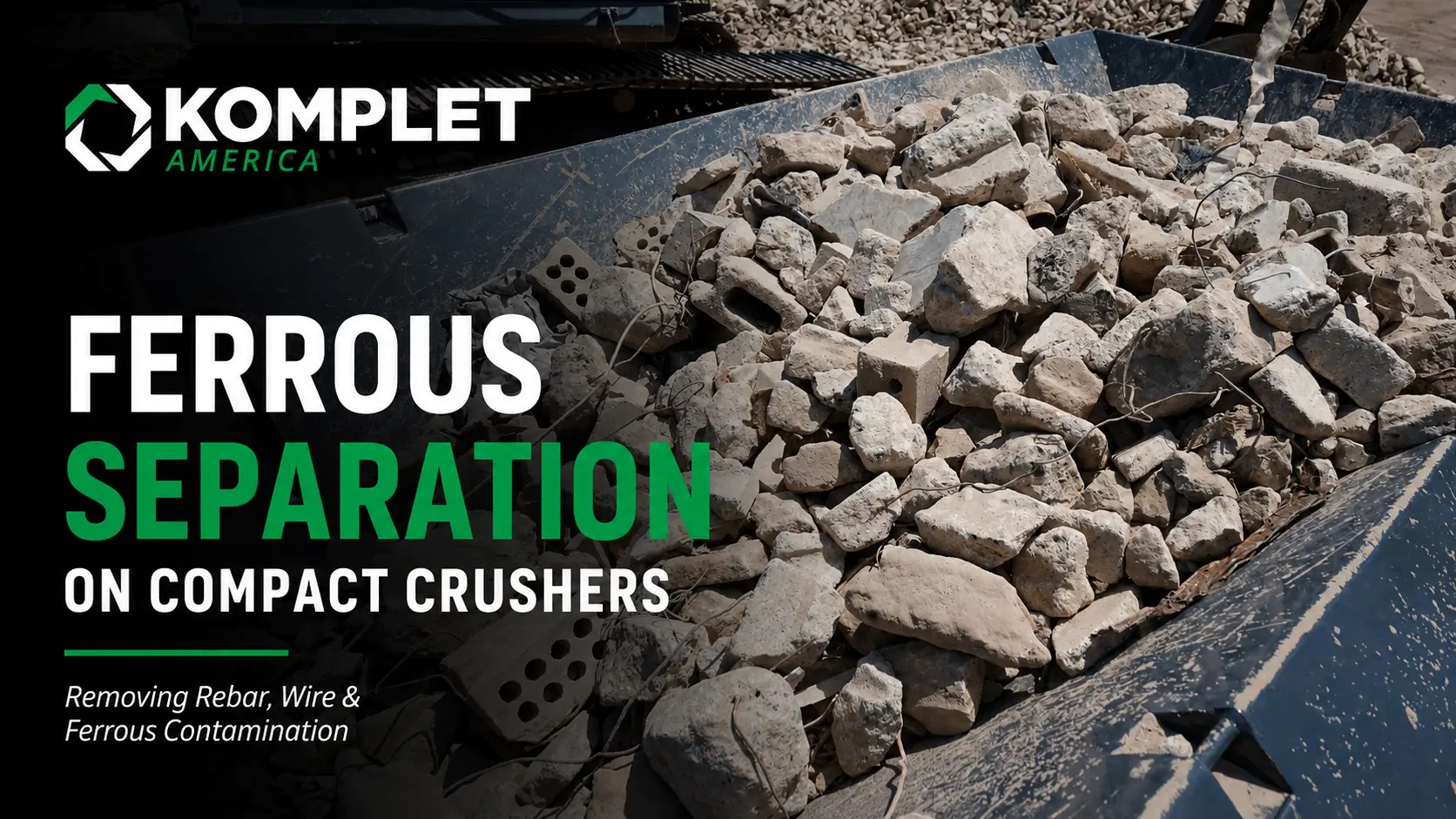
Yes, with appropriate equipment. Komplet K-JC 604, K-JC 704 PLUS, and K-JC 805 jaw crushers include integrated hydraulic magnetic belts that lift ferrous metal off the discharge conveyor during crushing. The metal lifts to a separate clean pile alongside the operation. The K-IC 70 compact impact crusher also includes an integrated magnetic belt. Oversize rebar exceeding the magnetic separator’s capacity should be pre-cut at the feed pile with a shear or excavator-mounted attachment. The K-JC 503 does not include integrated magnetic separation; rebar control is managed at the feed pile.
What’s the resale value of compact crushing equipment?
Komplet equipment holds strong resale value relative to most heavy equipment categories because the brand has steady demand in the compact crusher market and a national service network supporting both new and pre-owned units. Typical 5-year residual value for properly maintained Komplet equipment runs 50–70 percent of new purchase price, varying by model, hours, and condition. The strong residual value contributes to favorable lease and finance terms and reduces the effective amortization cost across the equipment life.
Final Thoughts
The economic case for on-site concrete crushing has shifted decisively over the past five years and continues to shift every quarter. Tipping fees have risen approximately 30 percent in inflation-adjusted terms since 2016 and 10 percent in 2024 alone. Virgin aggregate prices have followed similar trajectories. Landfill capacity is contracting — particularly in the Northeast — pushing fees higher at the remaining facilities. Regulatory mandates increasingly favor recycling. State DOT acceptance of RCA has broadened. Compact crushing equipment has matured into proven technology with established service networks and pre-owned markets that lower the capital threshold meaningfully.
The contractor or recycler treating disposal as a single line on the bid sheet — load it, truck it, pay the dump fee, move on — is operating on an accounting model that increasingly doesn’t reflect the true economics. The contractor running the full cycle comparison finds that on-site crushing is increasingly the cheaper path on the kind of work most contractors do every week. The math that was marginal a decade ago is mainstream now, and the trajectory points toward continued strengthening through the late 2020s.
None of this means every contractor should buy a crusher tomorrow. Operations with small volume, contaminated feed, no site access, no use for produced aggregate, or capital constraints are still better served by haul-away. The decision should always be made with the full cost-line comparison, regional-specific numbers, and an honest assessment of the operation’s fit. But for the contractor who does generate clean concrete demolition rubble on a regular basis, who has site or yard space for processing, and who can consume the produced aggregate or sell it locally, the case for owning compact crushing equipment is stronger than at any point in our experience. Komplet America’s specialists are happy to run the math with any operator considering the decision — call 908-369-3340 to start that conversation.
For the broader cluster of articles supporting this analysis, see: Crushed Stone Grades: A Komplet Basic Guide to Aggregate Size and Use Cases, The Hardscape Contractor’s Guide to On-Site Stone Production, State DOT Specs for Recycled Concrete Aggregate, Construction & Demolition Tipping Fees by Region, OSHA Silica Compliance for Crushing Operations, Permit Guide: Starting a Small-Scale Concrete Recycling Operation, Recycled Concrete Aggregate vs Virgin Stone, How to Produce #57 Stone from Concrete Rubble, and Crusher Run vs #57 Stone for Driveways.
Ready to Run the Numbers on Your Operation?
- Talk to a Komplet specialist about running a regional-specific cost comparison for your operation. Call 908-369-3340 or visit com/contact-us.
- Browse the full Komplet equipment lineup — crushers, impact crushers, screeners, conveyors, and shredders sized for compact contractor and recycling operations.
- Explore equipment financing through Komplet Capital — 24-hour approvals, terms from 36 to 72 months, 100% financing available.
- Consider a pre-owned Komplet machine — typical capital savings of 40 to 70 percent versus new, factory-supported by the same Komplet America service network.
Never enough.
Disclaimer: Tipping fee data is drawn from the Environmental Research and Education Foundation’s 2024 Analysis of MSW Landfill Tipping Fees, current as of late 2025 and early 2026. Tipping fees change frequently; the specific gate rate at any landfill, transfer station, or recycling facility on any specific date should be confirmed directly with the facility. Regional averages are illustrative and based on industry patterns; specific operations face market conditions that may vary substantially from regional averages. Any production rates, throughput figures, output capacities, or processing times referenced here are illustrative and provided for general reference only. Actual production varies with material type, size, moisture content, density, abrasiveness, and contamination, as well as feed method and consistency, crusher or screen settings, screen media selection, conveyor and stockpile configuration, site layout and access, ambient conditions, machine condition and wear, maintenance history, and operator experience. Capacity figures describe favorable conditions and are not a guaranteed, warranted, or contractual production standard. Any application, material, or production estimate should be confirmed through a material test or site evaluation with Komplet America or an authorized Komplet dealer before purchase or project commitment. Cost ranges, payback timelines, equipment economics, and worked examples are illustrative and based on industry patterns; actual results vary significantly by region, market, project specifications, equipment utilization, operator skill, financing terms, regulatory environment, and many other factors. Operating, maintenance, and service guidance is general in nature. Always refer to the official Komplet operator’s manual for the specific machine model and serial number, and follow OEM intervals and procedures. For warranty-protected work, contact Komplet America at 908-369-3340 or your authorized Komplet dealer. Improper service or non-OEM parts may void warranty coverage and create safety hazards.